




I give invited talks occasionally, to present my latest research in machine learning and its application for robot control.
If you would like me to give a presentation at your institution, please invite me!
You can download a tentative abstract of my invited talk here.
Robot Learning of Motor Skills
Abstract
Endowing robots with human-like abilities to perform motor skills in a smooth and natural way is a dream of many researchers. It has become clear now that this can only be achieved if robots, similarly to humans, are able to learn new skills by themselves. However, acquiring new motor skills is not simple and involves various forms of learning. Some tasks can be successfully transferred to the robot using only imitation strategies. Other tasks can be learned very efficiently by the robot alone using reinforcement learning. The efficiency of the process lies in the interconnections between imitation and self-improvement strategies.
In this talk, a variety of robot skill learning examples are presented, such as: autonomous valve turning using reactive policy learning, energy-efficient bipedal walking exploiting the passive compliance, whole-body motor skill learning for erasing a whiteboard, learning for improved control of autonomous underwater vehicles, etc. Throughout these examples, the important role of the policy representation for speeding up the learning process is highlighted.
Biography
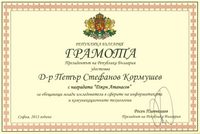
Dr. Petar Kormushev is a researcher and a team leader at the Advanced Robotics department of the Italian Institute of Technology (IIT). His research interests include robotics and machine learning, especially reinforcement learning for intelligent robot behavior. He obtained his PhD degree in Computational Intelligence from Tokyo Institute of Technology in 2009. He holds MSc degree in Artificial Intelligence and MSc degree in Bio- and Medical Informatics. He is a technical coordinator in two EU FP7 projects, as well as the recipient of the 2013 John Atanasoff award by the President of Bulgaria for outstanding young scientist.
You can find an old version of my invited talk here.